 K A
W A N A B EK A
W A N A B E
K A
W A N A B EK A
W A N A B E
T o k y o + S y d n e y - 1 9 9 3 + 9 4 |
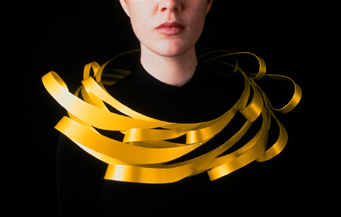
There is a specific aesthetic to which I am deeply attached. It exists so strongly inside me that I cannot ignore it in my creative expression. I have a fascination with form which expresses movement, which captures the ìmomentî of movement. It is very important to me that the process of the change involved in the formation of a work has to be visible in the end result. When a flat sheet of metal is turned into a 3D shape, I like that viewers can read the trace of the transformation in the form. I would like to present a kind of 'instant transformation' of the form or in other words to present the entire metamorphosis in one shape. This desire came from somewhere inside of me.
This aesthetic came from my childhood. The sense of excitement and satisfaction that I feel when I am working with paper models is related to the feeling that I remember when I was helping my father to make New Year's decorations, or some other ceremonial items when I was small. Also I remember that I never grew tired of watching local men or women making ceremonial decorations with simple materials like bamboo, straw, and paper with incredibly skilled hands, moving around just as in a magic trick to create the most beautiful things within minutes.
These simple craft techniques and methods of creation were developed within local comunities to make decorations for ceremonial occasions and festive days. Thus these 'crafts' could effectively turn an ordinary village space into an extra-ordinary place where people felt closer to their gods.
I am facinated by the fact that these special decorated environments exist only for a short time. This is the limited moment in which people can feel differently from their usual day to day life. The transformation happens very quickly, and the decoration goes up suddenly and is taken down immediately after the occasion.
Perhaps the special moment will be appreciated all the more if it lasts only for a short time. But there is something that I call ìephemeral aestheticsî in people's hearts, which is the longing to see beauty which doesnít stay long. I wonder if it is a fundamental human desire.
Jewellery, on the other hand, represents the human dream of absolute, eternal beauty. Jewellery conventionally creates a form of body adornment using more stable, long lasting and beautiful metals like gold, combined with rarely found radiant gems.
What I would like to achieve is to combine these two approaches. I try to visualise ephemeral forms in a more durable way, and at the same time attempt to contain or capture the power of transition.
Yuri Kawanabe
T O P
H O M EP A G E


